
Picture the scene: a client arrives for a nine o’clock meeting, and the first thing they see is an overflowing bin, a smeared glass door and coffee rings on the boardroom table. First impressions form fast, and a dirty office forms a bad one before a single word is spoken. But cleaning frequency is not just about appearances. It affects the health of your team, your compliance obligations and, according to peer-reviewed research on workplace cleanliness and employee productivity, even your bottom line. The question is: how often should you clean your office, and what does that actually look like in practice?
The honest answer is that it depends. Headcount, sector, layout and footfall all shift the dial. What works for a six-person design studio will not cut it in a 200-seat call centre. This guide walks you through every variable so you can build a schedule that protects your people, your reputation and your workspace.
Key takeaways
- High-touch surfaces such as door handles, keyboards and shared equipment need sanitising every single day.
- Restrooms and kitchens require daily cleaning as a minimum, and twice-daily attention in busy offices.
- Floors, windows and communal areas need weekly or fortnightly cleaning depending on traffic levels.
- A professional deep clean every three to six months tackles what routine cleaning misses and protects long-term air quality and asset condition.
- The right schedule is built around your specific office, not a generic checklist. Size, sector and headcount all change the frequency.
Why office cleaning frequency matters
It is easy to treat cleaning as a background task, something that happens before anyone arrives and is quickly forgotten. In reality, the frequency at which your office is cleaned has a direct bearing on three things your business genuinely cares about: the health of your team, their productivity and the impression you make on everyone who walks through the door.
Health and sick days
Offices are shared environments, and shared environments spread illness. Cold and flu viruses can survive on hard surfaces for up to 24 hours. Bacteria on a keyboard or shared phone can transfer to hands, then to faces, within minutes. The CDC guidelines for cleaning and disinfecting workplaces are clear: regular cleaning and targeted disinfection of high-touch surfaces are the most effective way to interrupt surface-to-hand transmission. Cut that transmission route and you cut sick days.
Productivity and morale
A clean environment is not just pleasant to look at. It changes how people feel about their work. Clutter and grime create low-level stress that erodes focus and signals to staff that their wellbeing is not a priority. A well-maintained workspace, by contrast, is one where people can concentrate and feel valued. The link between cleanliness and job satisfaction is backed by evidence, which is why investing in the right cleaning schedule is as much a performance decision as an operational one.
Compliance and legal duty
As an employer, you have legal obligations around workplace sanitation. OSHA workplace sanitation standards (29 CFR 1910.141) set binding requirements on everything from waste removal frequency to restroom provision and vermin control. While OSHA is a US standard, it reflects the same principles embedded in UK health and safety legislation. Cleaning frequency is not optional; it is part of your duty of care.
Factors that determine how often your office needs cleaning
Before you write a single task on a cleaning rota, you need to understand what drives the frequency requirement in your specific workplace. These are the variables that matter.
Headcount
More people means more surface contact, more food and drink in circulation, more waste generated and more bacteria transferred. A team of ten and a team of a hundred are categorically different cleaning challenges.
Foot traffic and visitors
External visitors introduce bacteria from outside your building. Reception areas, meeting rooms and shared toilets all see more contact when clients, couriers and contractors are coming and going throughout the day.
Sector and work type
A legal firm where people sit at desks has different needs to a food-adjacent business, a medical practice or an industrial workspace. Sector shapes both the type of cleaning required and the regulatory expectations around it.
Layout and surface types
Open-plan offices with shared hot desks need more frequent workstation sanitisation than private offices with fixed desks. Carpeted floors trap more particulate matter than hard floors. More meeting rooms mean more shared equipment to sanitise.
Time of year
Cold and flu season, hay fever season and any period of elevated illness in your team or wider community are all good reasons to increase frequency temporarily. Prevention is always cheaper than an office-wide sick week.
Recommended cleaning schedule by frequency
With those variables in mind, here is a practical framework for most office environments. Treat this as a starting point and adjust upwards wherever your headcount, traffic or sector demands it.
Daily cleaning tasks
These are the non-negotiables. Daily tasks keep your office safe, presentable and compliant with basic hygiene standards. Skip them and problems compound quickly.
- Sanitise all high-touch surfaces: door handles, light switches, lift buttons, shared phones and shared equipment.
- Clean and disinfect kitchen surfaces, sinks and appliance handles.
- Clean and sanitise restrooms, replenishing soap, paper towels and toilet roll.
- Empty all waste bins and remove rubbish to external collection points.
- Wipe down reception desks, front-of-house surfaces and any communal seating that has been used.
- Spot-clean glass doors and partitions where smears and fingerprints are visible.
- Sweep or vacuum high-traffic floor areas: reception, corridors, kitchen and breakout spaces.
Good to know: the products you use matter as much as the frequency. When selecting disinfectants for hard surfaces, look for EPA-registered disinfectants approved for office use. These have been formally assessed for efficacy against a broad spectrum of bacteria and viruses, so you can be confident they are actually doing the job.
Weekly cleaning tasks
Weekly tasks address areas that accumulate dirt more slowly but still need consistent attention. Leaving these any longer than a week means they become noticeably worse, and noticeably worse means complaints, or worse, illness.
- Vacuum all carpeted areas fully, including under desks and in corners.
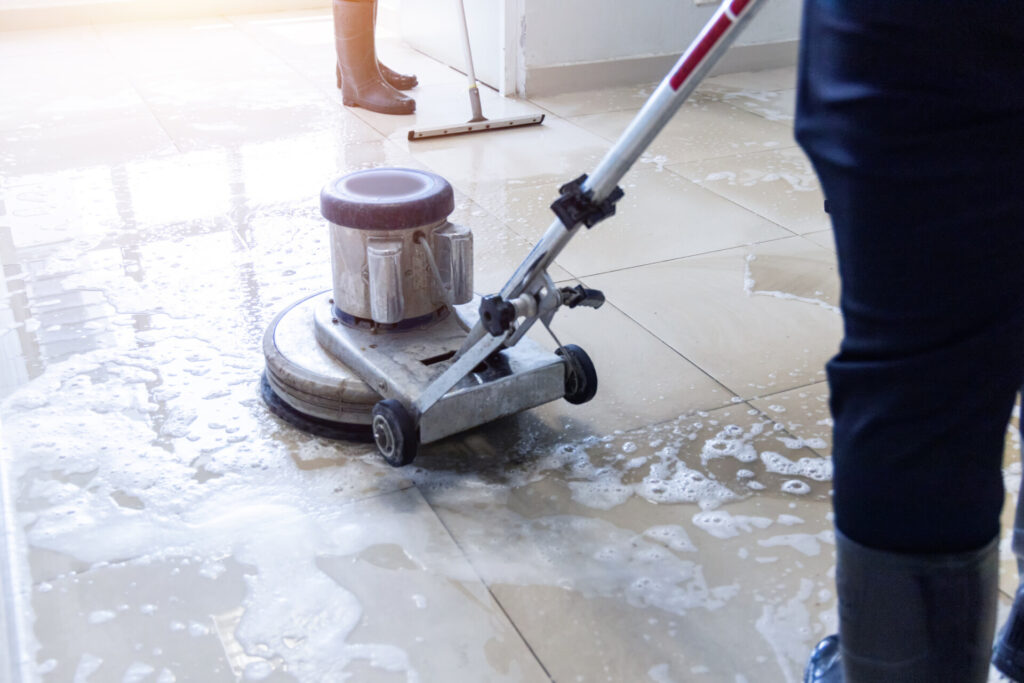
- Mop hard floors throughout the office.
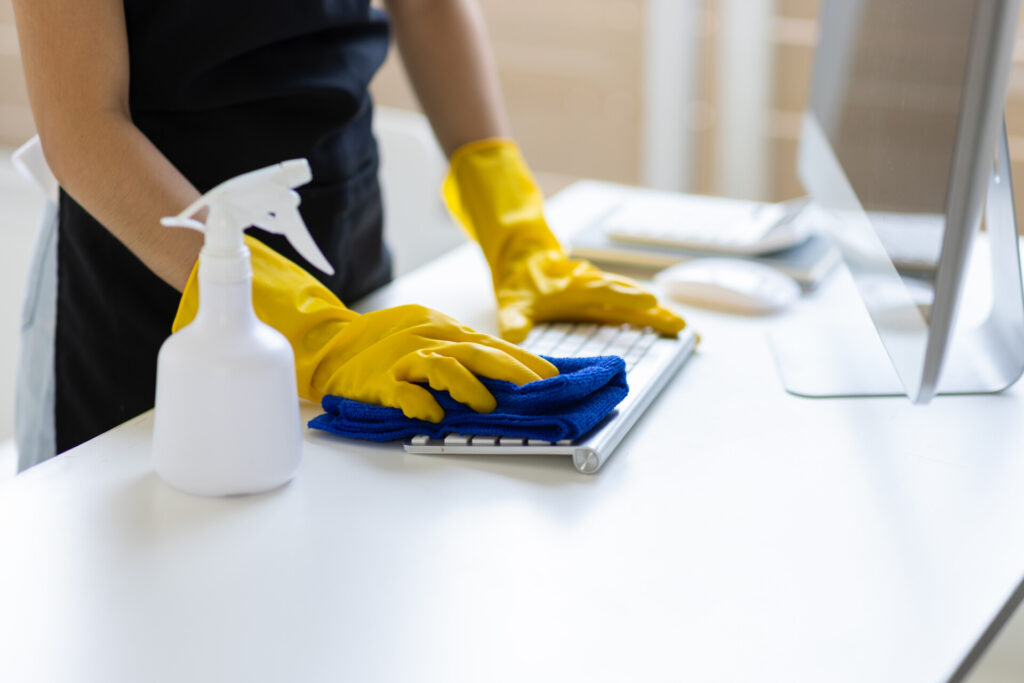
- Wipe down individual workstations: screens, keyboards, mice and desk surfaces.
- Clean the inside and outside of microwave ovens and other shared kitchen appliances.
- Sanitise the inside of fridge handles and wipe down shelves.
- Clean all internal glass and windows that are reachable without equipment.
- Dust horizontal surfaces: shelving, filing cabinets, windowsills and partition tops.
- Clean communal meeting room chairs and wipe conference tables thoroughly.
Monthly cleaning tasks
Monthly tasks target areas that are easy to overlook in daily and weekly routines but contribute significantly to air quality, hygiene and the overall condition of your office environment.
- Clean air vents and grilles to prevent dust recirculating through the office.
- Wipe down walls and skirting boards for scuffs, dust and smears.
- Deep-clean kitchen appliances, including the inside of ovens and coffee machines.
- Inspect and clean hard-to-reach areas behind printers and under furniture.
- Sanitise communal soft seating and breakout furniture.
- Check and clean extractor fans in kitchens and restrooms.
Quarterly and annual tasks
These are the tasks that protect the long-term condition of your building and assets. They are easy to defer, but deferring them means higher repair and replacement costs further down the line.
- Professional carpet cleaning or deep extraction, depending on traffic levels.
- External window cleaning on upper floors using appropriate access equipment.
- Full upholstery cleaning on any soft seating throughout the office.
- Inspection and cleaning of ceiling tiles and light fittings.
- Annual review and deep-clean of server rooms or comms cupboards where dust can cause equipment damage.
Area-by-area cleaning frequency

Different areas of your office face different pressures. Here is how to think about each zone specifically.
Restrooms
Restrooms are the area where cleaning frequency has the most direct and measurable impact on health. For a standard office, once-daily cleaning and sanitisation is the absolute minimum. For offices with more than 30 people, or where external visitors use the facilities regularly, twice-daily cleaning is the standard. OSHA restroom and sanitation requirements for workplaces set out employer obligations around clean, immediately available toilet facilities, and these exist for good reason: poorly maintained restrooms are one of the fastest routes for bacteria to spread through a building.
Between formal cleans, supplies should be checked and restocked every two to three hours during the working day. Running out of soap is not a minor inconvenience. It is a hygiene failure.
Kitchen and break room
Kitchens carry a disproportionate hygiene risk relative to their size. Food residue, moisture and warmth create exactly the conditions bacteria thrive in. Surfaces, sinks and appliance handles need wiping down daily. Microwaves and shared appliances need a thorough clean weekly. Fridges should be checked and cleared at the end of every week so that expired food does not become a source of contamination.
High-touch surfaces throughout the office
Door handles, lift buttons, shared printers, communal keyboards, light switches and meeting room screens all need sanitising every day. In a busy office, these should be part of a morning clean before staff arrive and, ideally, again at lunchtime if headcount is high. This single habit reduces surface-to-hand transmission more than almost any other cleaning intervention.
Workstations and desks
Fixed desks used by the same person every day can often be maintained with weekly sanitisation, provided the individual keeps the surface reasonably tidy. Hot desks, shared workstations and any desk used by visiting staff or contractors need wiping down between every single user. A shared desk that is not sanitised between users is, from a hygiene perspective, the same as using someone else’s kitchen without washing it first.
Floors
High-traffic areas, reception, corridors and kitchen floors, need daily sweeping or vacuuming and mopping. Office floors in quieter zones can be vacuumed or swept weekly and mopped fortnightly. Carpets in busy areas benefit from a professional extraction clean every three months; quieter areas can go to six months.
Meeting rooms
Meeting rooms see concentrated, repeated use. After every meeting, someone should wipe down the table and any shared screens or presentation equipment. A full clean of seating, surfaces and floors should happen daily. Meeting rooms that receive external clients need to be checked and refreshed before every scheduled visit, not just at the start of the day.
Industry and office-type considerations
Standard schedules are a baseline, not a ceiling. Certain environments need more, and there is no benefit in applying a generic schedule where the risk profile demands something more robust.
Small offices
A small team in a low-traffic space can often work to a lighter daily schedule, perhaps high-touch sanitisation and bin removal each day, with a fuller clean three times a week. But even small offices need a proper weekly clean of the kitchen and restrooms and a monthly dust-and-vent check. Size does not remove the obligation; it just changes the scale.
Corporate and multi-floor offices
Large offices with multiple floors, high headcount and constant visitor flow need a full daily clean across all areas, with a dedicated porter or cleaning operative on-site during the working day to manage ongoing needs. For a real-world illustration of how this works in practice, this real-world office cleaning case study for a high-traffic building documents how one multi-storey office reduced cleanliness complaints by 90% within two months by introducing a structured porter service with regular audits.
Coworking spaces
Coworking environments face the toughest challenge: multiple businesses, revolving membership and continuous visitor access across a single day. Hot desks and shared facilities need sanitising between users as a standard protocol, not an exception. Kitchens and restrooms in coworking spaces are often better served by twice-daily formal cleans and a midday refresh.
Sector-specific requirements
If your business sits in a regulated or high-risk sector, cleaning frequency moves from best practice into legal and contractual requirement. Our cleaning services across London sectors cover environments from education through to industrial premises, each with its own compliance framework. School and education cleaning in London, for example, requires attention to child-safe products, increased surface sanitisation and strict scheduling around school hours. Hospitality and hotel cleaning services operate to a completely different rhythm, driven by check-in and check-out times and the expectation of an immaculate environment at every guest visit. Industrial settings require specialist approaches: our industrial cleaning services in London are built around the specific hazards and compliance needs of those environments.
When and how often do i deep clean an office?
Regular cleaning maintains the standard. Deep cleaning resets it. Both are necessary; neither replaces the other.
Deep cleaning is not simply a longer version of your weekly routine. It tackles the areas that regular cleaning never reaches: the back of appliances, under and behind furniture, grout lines in tiled surfaces, upholstery fibres, carpets at a deep-extraction level and air conditioning units. Over time, these areas accumulate bacteria, allergens, dust and mould spores that affect air quality and the health of anyone in the space.
For most offices, a professional deep clean every three to six months is the right baseline. Offices with high footfall, kitchens in regular use, or a recent period of illness among staff should lean towards three months. Quieter offices with lower traffic can often manage with two deep cleans per year, supplemented by thorough monthly attention to the areas most at risk.
deep cleaning is also the moment to assess the condition of your office assets. Worn carpet, damaged seating and deteriorating surfaces are much easier to spot when everything has been moved and thoroughly cleaned. Many of our clients use deep clean visits as a planned opportunity to review what needs repair or replacement.
In-house cleaning versus professional cleaning
This is a question we hear often. The answer depends on two things: the size of your team and the standard you need to maintain.
When in-house works
For a very small office, a daily tidy-and-wipe routine carried out by whoever is first in the door can be perfectly adequate. If there are fewer than ten people, footfall is low and there are no external visitors or regulatory requirements, in-house cleaning can keep things ticking over between professional visits.
When professional cleaning is the right choice
As soon as headcount grows, visitor numbers increase or the physical footprint of your office expands, in-house cleaning becomes inconsistent. It also becomes an unwanted overhead for your team, taking time and focus away from the work they are actually there to do. Professional cleaners bring trained staff, commercial-grade equipment, proven products and a documented schedule that gives you an auditable record of what was cleaned and when. That record matters if you ever face a health and safety inspection or a staff complaint about workplace conditions.
Our commercial cleaning services in London are built around your schedule, your office and your sector. We do not apply a template. We look at how your workspace actually operates and build a cleaning plan that fits around it.
Frequently asked questions
How often should you clean your office?
Most offices need daily cleaning of high-touch surfaces, kitchens and restrooms, weekly vacuuming and desk sanitisation, monthly attention to vents and communal areas, and a professional deep clean every three to six months. The right frequency depends on your headcount, foot traffic and sector.
How often should office restrooms be cleaned?
Restrooms in a busy office should be cleaned and sanitised at least once a day, and twice daily in high-footfall environments. Supplies should be checked and replenished every few hours during the working day. OSHA restroom and sanitation requirements for workplaces make clear that clean, immediately accessible toilet facilities are an employer obligation, not a courtesy.
What is the difference between regular cleaning and deep cleaning?
Regular cleaning covers day-to-day and weekly tasks that keep the office presentable and hygienic. Deep cleaning goes further, tackling areas that routine cleaning misses: inside appliances, behind furniture, upholstery, grout lines, air vents and carpets at extraction level. Most offices need a professional deep clean every three to six months.
Can we handle office cleaning in-house?
Small offices with low footfall can often manage daily tidying in-house, but weekly and deep-cleaning tasks benefit from professional equipment and trained staff. As headcount or visitor numbers grow, in-house cleaning becomes inconsistent and time-consuming. A professional contractor delivers a documented, auditable schedule that protects both health and compliance.
How does office cleaning frequency affect employee productivity?
A clean environment reduces sick days caused by surface-to-hand transmission, signals to staff that their wellbeing matters, and creates the kind of focused, clutter-free space where people do their best work. The evidence backs this up: peer-reviewed research on workplace cleanliness and employee productivity shows a significant positive relationship between measured cleanliness and job satisfaction among office workers.
Is your current cleaning schedule actually doing its job?
Run through this checklist before deciding. If you can answer yes to all of these, your schedule is working. If any give you pause, it probably needs a rethink.
- Are high-touch surfaces sanitised every working day without exception?
- Are restrooms cleaned at least once daily, with supplies checked throughout the day?
- Has your office had a professional deep clean in the last six months?
- Do hot desks and shared workstations get sanitised between users?
- Is your cleaning schedule documented so you can show it if asked?
- Does your schedule account for any sector-specific requirements your business faces?
If you are reading this guide, you already know that cleaning frequency matters. The next step is making sure your current approach is genuinely fit for purpose, not just what has always been done.
Get a cleaning schedule built around your office
We work with businesses across London to build cleaning plans that actually match the way their offices operate. No templates, no guesswork. Just a practical, documented schedule that keeps your workplace safe, compliant and ready for every working day. You can find out more about Cresswell Services and the way we work, browse our Cresswell cleaning news and insights for practical workplace hygiene advice, or get a free cleaning quote and we will come back to you with a plan that fits your office, your team and your budget.